

Service: Seismic Methods
Platforms
Molab
Techniques
No
techniques found
Technology Readiness Level
9 - service proven in operational environment (production)
Organization
Service contact persons
Phone:302831106019
Seismic methods investigate subsurface structures by analysing P-wave and surface-wave propagation through soils and rocks. Seismic Refraction Tomography and Multichannel Analysis of Surface Waves reveal variations in material density, rigidity, saturation and stratigraphy. The service produces velocity profiles and sections supporting archaeological detection, geological interpretation, geotechnical assessment, aquifer mapping and hazard investigation.
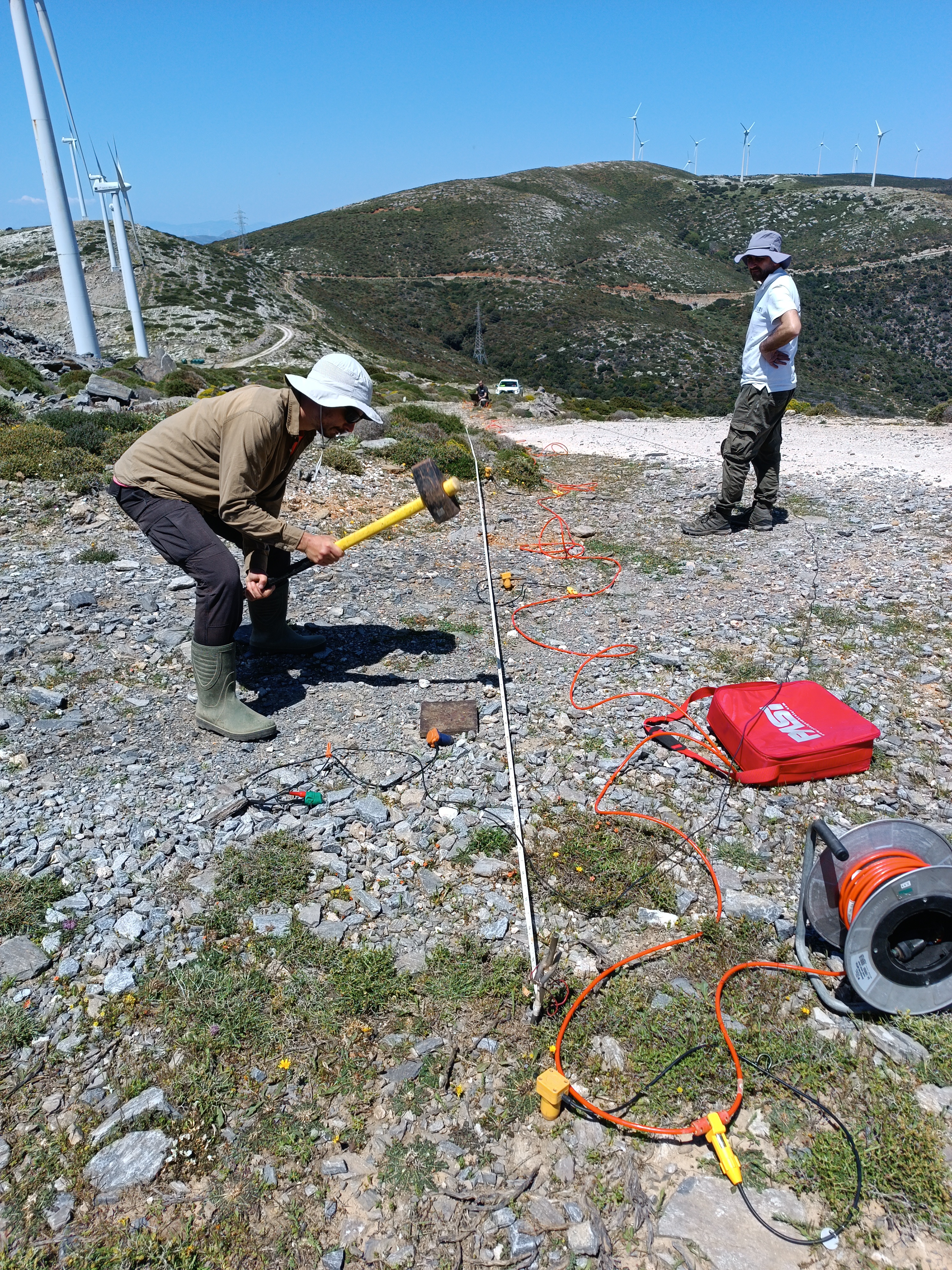
Seismic methods investigate subsurface structures by analysing the propagation of compressional waves through soils and rocks. Seismic Refraction Tomography measures the first-arrival times of waves whose velocities vary according to material properties such as density, rigidity, saturation and homogeneity. When seismic waves encounter boundaries between materials with different velocities, they change direction according to Snell’s Law, allowing geological layers, lithological contacts and approximate interface depths to be identified. During field acquisition, an impulsive source—typically a hammer striking a metal plate—generates seismic energy, while geophones or hydrophones positioned along a profile record the arriving signals. Travel-time curves and changes in their slope indicate velocity contrasts within the subsurface. Tomographic processing begins with an initial velocity model and iteratively compares calculated and measured travel times, adjusting the model until an acceptable fit is achieved. Multichannel Analysis of Surface Waves (MASW) is a seismic method that analyses the dispersion of surface waves to estimate subsurface S-wave velocity variations. In terrestrial and shallow marine environments, it uses Scholte waves travelling through seabed sediments. Recorded dispersion curves are inverted to produce velocity profiles and two-dimensional S-wave pseudo-sections. Seismic methods support the detection of buried archaeological remains, geological hazards, aquifer geometry, stratigraphic boundaries and other subsurface features, although resolution depends on wavelength, source frequency, receiver spacing and array length.
Fields of application
Engineering
Geology
Sedimentology
Stratigraphy
Structural geology
Materials
Soil
Sedimentary rock
Beachrock
Extrusive rock
Igneous rock
Methods
Tools
Other information
-
Output: • 2-D P-wave seismic velocity sections • 1-D & pseudo 2-D S-wave profiles and sections • Compilation of stratigraphic/geological/geotechnical models