

Service: Neutron-based elemental analysis
Platforms
Fixlab
Techniques
Neutron activation analysis (naa)
Prompt gamma activation analysis (pgaa)
Technology Readiness Level
9 - service proven in operational environment (production)
Organization

Service contact persons
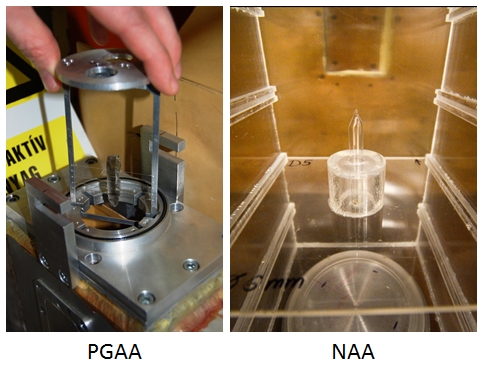
PGAA and NAA are nondestuctive bulk elemental analytical methods, with which the chemical compositions of various materials can be determined. The methods are based on the detection of the characteristic gamma radiation following the capture of neutrons into atomic nuclei. The types of the investigated materials include stones, ceramics, metals, glass, etc. This service is available at the Budapest Neutron Centre.
Prompt Gamma Activation Analysis (PGAA) is a nondestructive, noninvasive bulk analytical tool for determination of elemental composition, based on the detection of prompt-gamma radiation induced by neutron capture into the atomic nucleus. Large objects can be placed in an external neutron beam without sampling. The method is suitable to quantify the most major components and some minor and trace elements (e.g. B, Cl, Co, Cd, Hg, Sm and Gd) in rocks, minerals, ceramics, glass, metals and many inorganic materials. Compared to other analytical techniques, the PGAA has lower sensitivity for many geochemically important trace elements, thus application of complementary techniques are recommended. Neutron activation analysis (NAA) is a method for quantitative composition analysis of chemical elements based on the irradiation of samples in the core of a research reactor, followed by the measurement of characteristic gamma spectra. The k0-standardized neutron activation analysis (k0-NAA), combined with high-resolution and high throughput gamma-ray spectrometry, offers mostly nondestructive, multi-elemental analysis for many branches of science and technology. NAA has inherently favorable characteristics, negligible matrix effect, excellent selectivity and high sensitivity. Even small amount (few tens of milligrams) of samples (mostly solid) can be measured, in which about 35–75 elements in less than 0.01 μg quantities can be determined. While PGAA is applicable more for quantification of the major geochemical components, NAA provides the concentrations of a series of trace elements. With the combination of PGAA and NAA, samples of geological origin can be characterised in detail. Prompt-gamma activation analysis can be performed on PGAA and NIPS instruments. Furthermore, at NIPS-NORMA station, combining the position-sensitive PGAA and neutron radiography/tomography, it is possible to determine localized amount of major elements and to visualize internal structures of heterogeneous objects in a non-destructive way.
While PGAA is absolutely nondestructive, NAA in most cases is destructive.
Fields of application
Heritage science (cultural heritage discipline)
Materials
Stones
Ceramic (material)
Glass
Metals and alloys
Soil
Plaster