

Service: dür.air - digital unfolding of reality through augmented interpretative representation
Platforms
Digilab
Techniques
Uav photogrammetry and aerial multispectral models
Uav-lidar
Technology Readiness Level
7 - operational service prototype demonstrated (beta)
Organization

Service contact persons
Reference
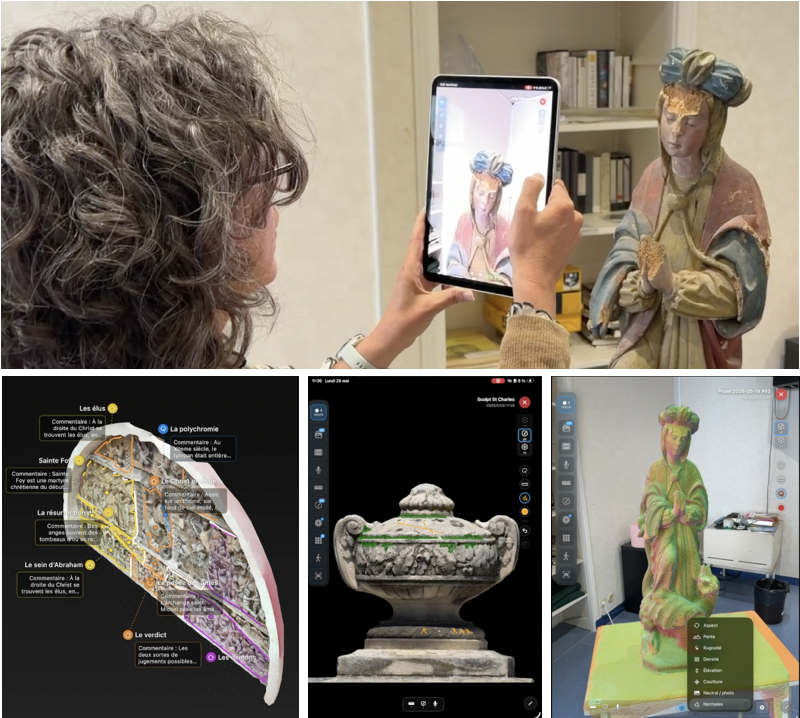
Dür.air is a mobile augmented reality application conceived as a field-based extension of the scientific and epistemological framework developed within the n-Dame_Heritage project. Its name reflects its core ambition: the digital unfolding of reality through augmented interpretative representation — reconciling observation, interpretation, and documentation at the place and moment where scientific observation is produced, by embedding spatial, temporal, and semantic information directly within in situ investigation.
In archaeology, conservation–restoration, architectural history, materials science, and landscape studies, knowledge emerges through situated practices: inspection, comparison, measurement, annotation, and the progressive construction of interpretative hypotheses. Where 3D digitisation often separates acquisition and interpretation in time and space, dür.air keeps geometry, semantics, and observation tightly coupled in a single mobile and autonomous environment.
Combining persistent augmented reality tracking, real-time LiDAR sensing, and on-device photogrammetric reconstruction, the platform supports a progressive “unfolding” of the object or site — an evolving augmented representation built across successive field sessions. On a single device (currently iPad Pro or iPhone Pro with LiDAR) and without network connectivity, it covers the full chain of field documentation: annotation, structured semantic description, metric measurement, dense 3D modelling, orthophoto and profile computation, interactive analysis, and the replay of spatio-temporal observation trajectories. Geometry remains a support for interpretation, memory, and cumulative reasoning.
When connectivity is available, projects can be deposited on a server node for institutional archive, sharing, and web publication — while field work itself stays fully offline.
Currently dür.air works only on iPad Pro of iPhone Pro with LiDAR (2020 or later). The beta version is open to heritage researchers and professionals interested in testing the application in real fieldwork situations and contributing feedback to improve the system.
Fields of application
Architectural conservation
Field archaeology
Materials science
Methods
Tools