

Service: FORTH laser cleaning and conservation
Platforms
Fixlab
Techniques
Other
laser cleaning, laser ablation, laser mending
Technology Readiness Level
9 - service proven in operational environment (production)
Organization
Service contact persons
Phone:302810391870
Cultural heritage objects are continuously threatened by surface contamination, degradation, and the formation of defects such as cracks and craquelure. Conservators therefore require highly precise, minimally invasive methods that can selectively remove unwanted deposits or repair damaged surfaces without compromising the original material.
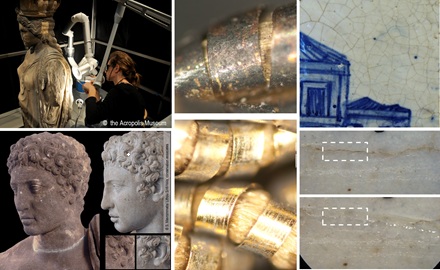
Laser ablation offers such a solution through the controlled interaction between laser radiation and matter, enabling intentional and highly localized modifications of the material. In this context, lasers have become sophisticated conservation tools for both cleaning and mending.
For cleaning applications, lasers function as "light scalpels," selectively removing unwanted surface layers while preserving the underlying sensitive historic substrate. For mending applications, they can act as minute "light blowtorches," locally melting a controlled volume of glaze to bridge and fill gaps created by craquelure.
For more than 30 years, IESL-FORTH has been conducting pioneering research to optimize laser processing parameters according to the physicochemical properties of each material. This work has enabled the development of highly precise, effective, and safe laser-based methodologies tailored to the conservation of cultural heritage.
Fields of application
Applied physics
Archaeological conservation
Archaeology
Architectural conservation
Art (discipline)
Conservation (discipline)
Conservation science (cultural heritage discipline)
Decorative arts (discipline)
Heritage science (cultural heritage discipline)
Materials science
Metallurgy
Natural history
Photonics
Materials
Varnish
Acrylic paint
Protective coating
Adhesive
Oil varnish
Picture varnish
Crust
Soil
Biological material
biodegradation
degradation layers
degradation products
metall corrosion products
Oil paint (paint)
Alkyd paint
Paintings
mural painting
Glazed terracotta
Blue-and-white (ceramic glaze)
Protective glazing
Ceramic glaze
Overglaze (material)
ceramic glazes
paint glazes
Methods
Other information
-
Input: Characterisation of involved materials (unwanted overlayers-authentic surface), cleaning limits, dimensions of the object, previous conservation treatments and other historical evidence, images (current and past-if available)
-
Output: Report, opertive parameters, cleaning methodology, images