

Service: Luminescence Dating of Ceramics and Sediments
Platforms
Fixlab
Techniques
Optically stimulated luminescence (osl)
Thermoluminescence (TL)
Technology Readiness Level
9 - service proven in operational environment (production)
Organization

Hungary
Service contact persons
Phone:36707024135
Phone:36305318702
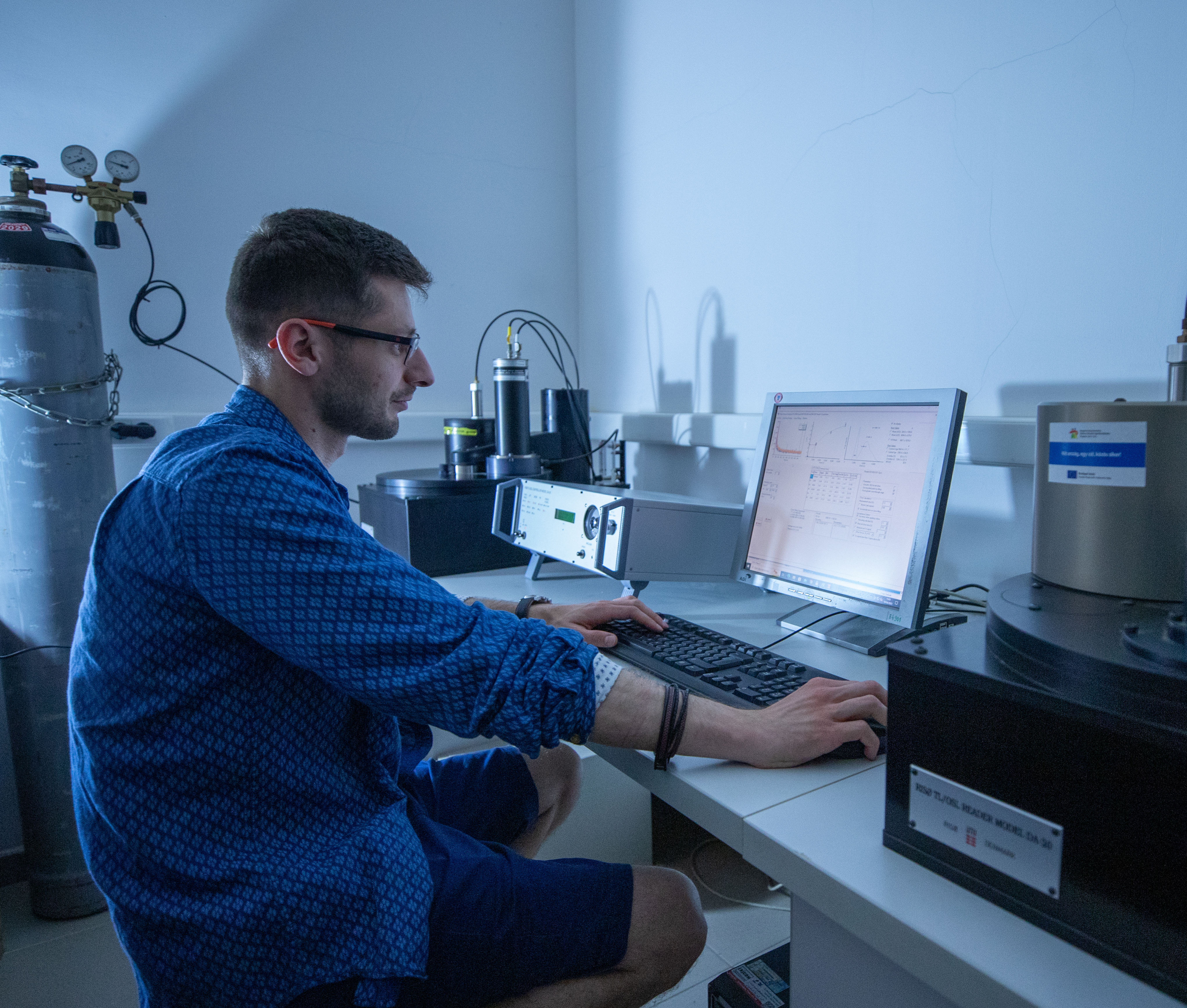
Luminescence Dating is routinely used to determine the time elapsed since the last firing of terracotta artworks, archaeological objects, pottery, bricks, or other heated materials, and the time elapsed since the deposition of various types of inorganic sediments. It is ideal in contexts where organic material is not available for dating.
Luminescence dating, including Thermoluminescence (TL) and Optically Stimulated Luminescence (OSL), determines the time elapsed since crystalline minerals such as quartz and feldspar were last exposed to a resetting event. In TL dating, this event is the strong heating or firing of materials such as ceramics, pottery, bricks or burnt archaeological objects. In OSL dating, the last exposure of sediment grains to sunlight generally corresponds to the time of sediment deposition and burial.
Following heating or burial, natural environmental radiation causes electrical charges to become trapped within defects in the mineral crystals. In the laboratory, these charges are released by reheating the sample in TL dating or exposing it to controlled light in OSL dating. The released energy is emitted as luminescence, the intensity of which indicates the radiation dose accumulated since the resetting event. The age is calculated by dividing the accumulated dose by the annual environmental radiation dose rate.
TL dating is commonly used to test the authenticity of ceramic art objects and to date archaeological pottery more precisely. Sampling is destructive, requiring approximately 50–100 mg of material for authenticity testing and 500–1,000 mg for standard pottery dating. The typical relative error is 10–20% for authenticity testing and 5–10% for standard archaeological dating. The method can generally date materials from a few decades to approximately 40,000–50,000 years.
OSL dating can be applied to sand- and silt-rich sediments from a wide range of archaeological and environmental contexts. Typical applications include environmental reconstruction, determining sedimentation rates, and dating the burial or abandonment of archaeological objects, buildings and ditches. Sediment samples must be collected without exposure to light, usually by hammering light-tight tubes or cylinders into the investigated profile. Approximately 200–300 g of sediment is required to measure the accumulated dose, along with an additional 500–1,000 g of surrounding sediment to determine the environmental dose rate. Reliable OSL ages require the mineral grains to have been sufficiently exposed to sunlight before burial; incomplete bleaching may result in age overestimation. The typical relative error is 5–10%. Quartz grains can generally be dated from a few decades to approximately 40,000–50,000 years, while feldspar grains may extend the applicable age range to approximately 300,000 years.
The precision and accuracy of both methods depend on sample quality and size, the available information about past and present environmental conditions, and the reliability of the estimated environmental radiation dose rate.
Limitations: In case of museum specimens, the environmental conditions and environmental dose rate might be difficult to assess or reconstruct, which will increase the uncertainty af the reported age. In terms of sediments, too short sunlight exposure during sediment transport can lead to age overestimation, a typical problem for example of silt-sized river sediments.
Fields of application
Archaeology
Archaeometry
Buildings archaeology
Chronology (discipline)
Environmental archaeology
Geoarchaeology
Geomorphology
Heritage science (cultural heritage discipline)
Landscape archaeology
Paleogeography
Physical geography
Materials
Terracotta (clay material)
Architectural terracotta
Fired brick
Floor brick
Kiln brick (brick)
Ceramic (material)
Ceramics
ceramic
Ceramic tile
pottery
sherd
Sand
Silt
Sediment
Other information
-
Input: Artwork and pottery: high-resolution image of the objects to be dated by indicating the scale and potential sampling point(s) (.tiff, .jpg), and a short description of the background information of the object (.doc). A short report on previous measurements made on the object (.doc). Sediments: a map showing the topographical/archaological/geomorphological context and planned sampling sites (.pdf), photo or sketch of the sampled or the proposed sampling profile (.tiff, .jpg). A list of previous studies (archaeological, geomorphological, sedimentological, etc.) in the area with references if possible.
-
Output: measurement files in .binx and .cnf, measurement results in .xls, reports