

Service: Opentheso-Espadon - Thesaurus Management and Edition Tool
Platforms
Digilab
Techniques
No
techniques found
Technology Readiness Level
9 - service proven in operational environment (production)
Organization

Service contact persons
Opentheso-Espadon lets you create or import a thesaurus by entering concepts, terms, and semantic relations through a collaborative interface. The platform turns this input into a structured, exportable vocabulary in standard formats that you can directly reuse in databases, annotation tools, and heritage science workflows.
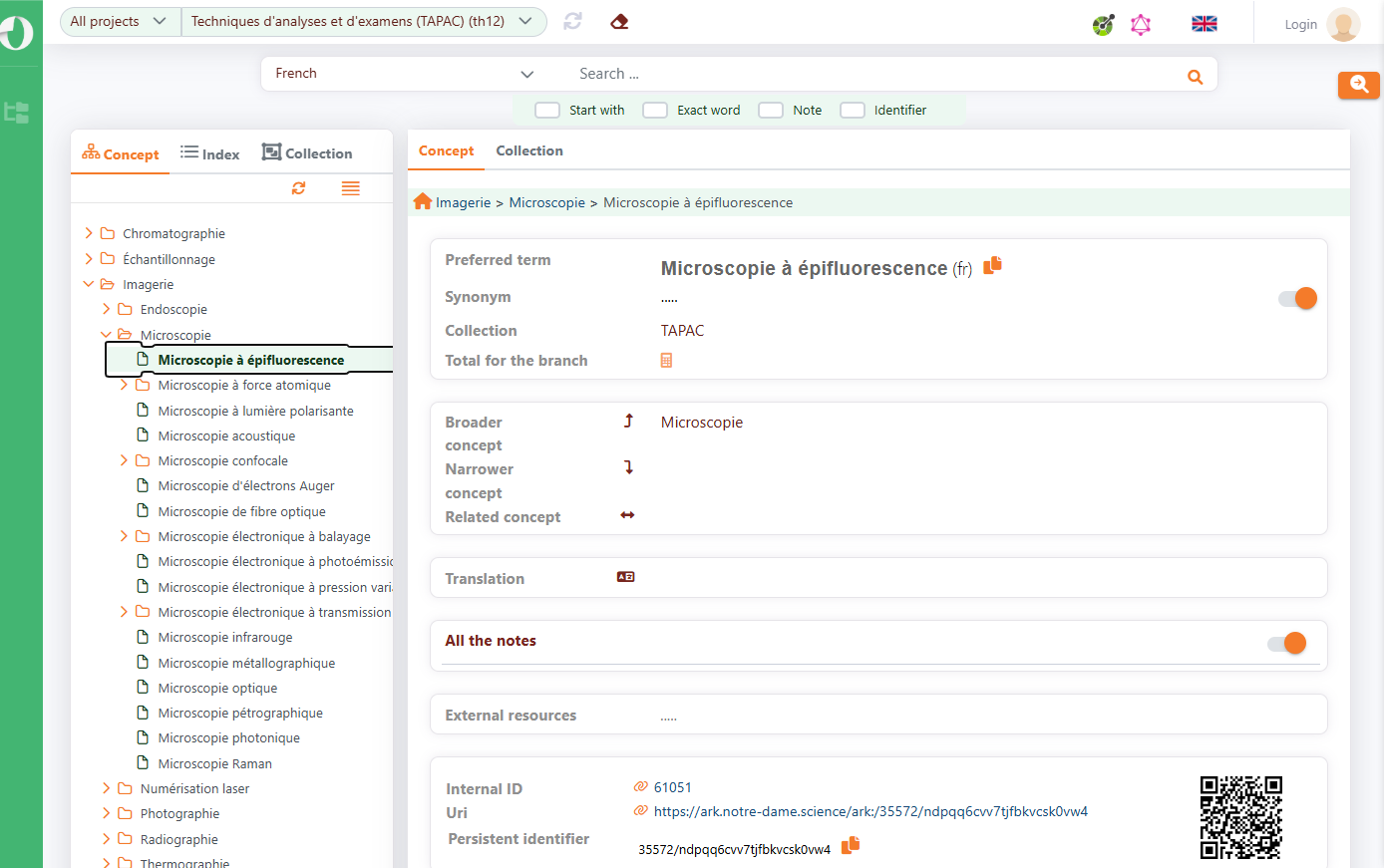
Opentheso-Espadon is a collaborative platform for creating, editing, and managing thesauri dedicated to Heritage Science. It allows experts to structure domain knowledge by organizing concepts, preferred terms, synonyms, and semantic relationships in a controlled and shared environment.
Through an intuitive web interface, users can:
Create and maintain thesaurus concepts,
Define multilingual labels and synonyms,
Establish hierarchical and associative relations,
Document concepts with notes and references,
Collaborate with other contributors through role-based workflows.
Fields of application
Conservation science (cultural heritage discipline)
Heritage science (cultural heritage discipline)
Humanities
Science-related disciplines
Other information
-
Input: Opentheso-Espadon requires as input the content and structure of a thesaurus to be edited or created. Users provide domain terminology in the form of concepts, preferred terms, synonyms, multilingual labels, and hierarchical or associative relations. Basic editorial information such as definitions, scope notes, and sources can also be added to document each concept. The platform accepts thesaurus data entered manually through the interface or imported from existing files in standard formats (e.g., SKOS/RDF or CSV). These inputs form the basis for collaborative editing, validation, and long-term governance of the thesaurus.
-
Output: Opentheso-Espadon outputs a structured, reusable thesaurus ready to be integrated into research and documentation systems. The platform produces controlled vocabularies organized as concept hierarchies, including preferred terms, synonyms, multilingual labels, scope notes, and explicit semantic relations. Each concept is associated with identifiers and editorial metadata that ensure traceability and stable referencing. The thesaurus can be exported in interoperable standard formats such as SKOS/RDF, JSON, and CSV, allowing direct reuse in databases, annotation workflows, and semantic infrastructures. The result is a machine-readable semantic resource that supports consistent terminology and interoperability across heritage science projects.