

Service: HSPortal - Semantic Artefact Catalogue
Platforms
Digilab
Techniques
Big data analytics
Data analysis
Data cleaning
Data integration
Data mining
Data presentation
Data processing
Data science technique
Data transformation
Data visualization
Database searching service
Geospatial data analysis
semantic annotation; data indexation; thesaurus; ontology
Technology Readiness Level
7 - operational service prototype demonstrated (beta)
Organization
Service contact persons
Phone:33630005089
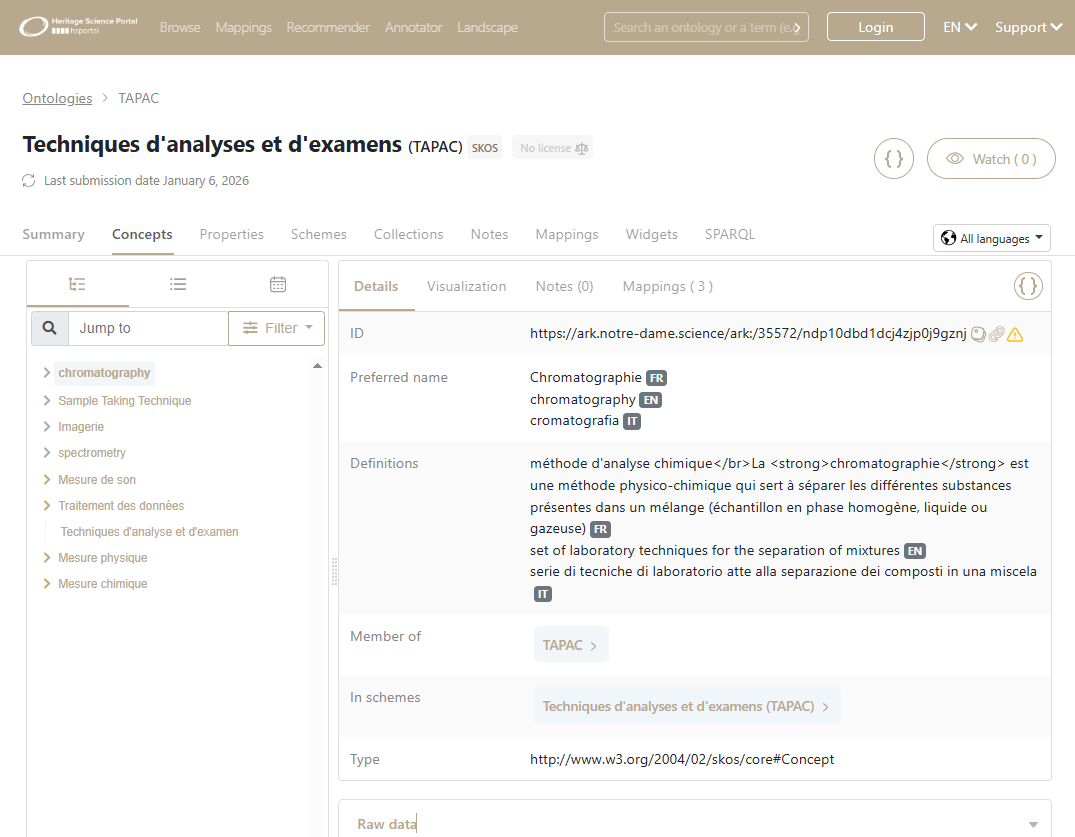
This service is a Semantic Artefact Catalogue: The users go to HS Portal to search for concepts related to their domain (e.g. materials, conservation treatments, analytical techniques), explore existing thesauri or ontologies used by other projects, understand how concepts are defined and structured.
HS Portal acts as a single entry point to semantic resources that are otherwise scattered across projects, institutions, or repositories. It comprises ready-to-use ontologies, thesauri, metadata schemas dedicated to Heritage Science research and documentation.
Are you a researcher or practitioner who needs to describe materials, analytical techniques, or conservation interventions in a Heritage Science project?
Are you a researcher or practitioner working with heritage data who needs consistent terminology?
Are you involved in a Heritage Science project that requires shared vocabularies or thesauri?
Do you work with heritage datasets that need to be described, documented, and reused over time?
If you are currently using ad-hoc term lists, spreadsheets, or undocumented labels, HS Portal can help. It allows you to search for existing thesauri and vocabularies already used in Heritage Science, explore how terms are defined, and reuse stable concept identifiers directly in your databases, annotation tools, or documentation. This helps ensure that everyone in your project uses the same terminology and that your data can later be understood, compared, and reused by others. When your work leads to new or refined vocabularies based on field or laboratory practice, these can be published in the portal so they remain documented, citable, and reusable beyond the project itself.
HS Portal is an online catalogue that helps the Heritage Science community find, understand, and reuse semantic resources such as thesauri, vocabularies, ontologies, and controlled terminologies. It is designed for researchers, heritage professionals, data managers, and infrastructure builders who work with complex, interdisciplinary heritage data and need shared concepts to describe, link, and interpret it. HS Portal is built as an instance of OntoPortal, a widely used open platform for managing and publishing semantic artefacts.
What does HS Portal offer?
HS Portal provides:
- A curated catalogue of thesauri, ontologies, and vocabularies relevant to Heritage Science,
- Clear documentation for each resource: scope, structure, authorship, versions, and use cases,
- Search and navigation tools to explore concepts across domains (materials, techniques, places, periods, processes…),
Persistent identifiers that support citation, reuse, and long-term access,
- Alignment and comparison features to understand relationships between different vocabularies.
The portal is not just a storage space: it is a working environment for semantic resources.
Fields of application
Archaeological conservation
Architectural conservation
Artificial intelligence
Big data analytics
Conservation (discipline)
Data analysis
Data integration
Data mining
Data presentation
Data processing
Data transformation
Data visualization
Field archaeology
Heritage science (cultural heritage discipline)
Humanities
Ontology (metaphysics)
Preventive conservation
Other information
-
Input: *If you want to publish or register a semantic artefact (thesaurus, ontology, etc): To add a thesaurus, vocabulary, or ontology to HS Portal, you will need to provide a minimum set of structured information. Required inputs: 1/The semantic resource itself: A thesaurus, controlled vocabulary, or ontology, ideally in a standard format (e.g. SKOS, OWL), but support is available if formats need clarification. 2/Basic metadata: -title and short description, -domain and scope (what the resource covers), -authors or responsible institution, -license and reuse conditions, -version information. 3/Concept definitions: -Concepts should be clearly named and described, in at least one language. 4/Optional but recommended inputs: -mappings or alignments to other vocabularies, -usage examples or project context, -governance information (who maintains it, how updates are managed). *If you want to maintain or evolve a resource: For ongoing use, the portal supports versioning and updates. Inputs may include: -revised or extended concept lists, -updated definitions, -documentation of changes between versions. This ensures that semantic artefacts remain usable and citable over time, beyond the lifespan of a single project.
-
Output: *If you want to reuse a semantic artefact (thesaurus, ontology, etc): You do not need to create new content, but you should have: -a research or professional use case (e.g. describing materials, analytical methods, places, historical periods), -an understanding of how the vocabulary will be used (annotation, database fields, interoperability, documentation). HS Portal provides: -persistent identifiers, -downloadable formats, -documentation that supports correct reuse. -No technical expertise is required.