

Service: Mobile platform for massive image-based 3D digitization of CH objects
Platforms
Molab
Techniques
No
techniques found
Cross-polarisation, RTI, Photometric Stereo
Technology Readiness Level
7 - operational service prototype demonstrated (beta)
Organization
Service contact persons
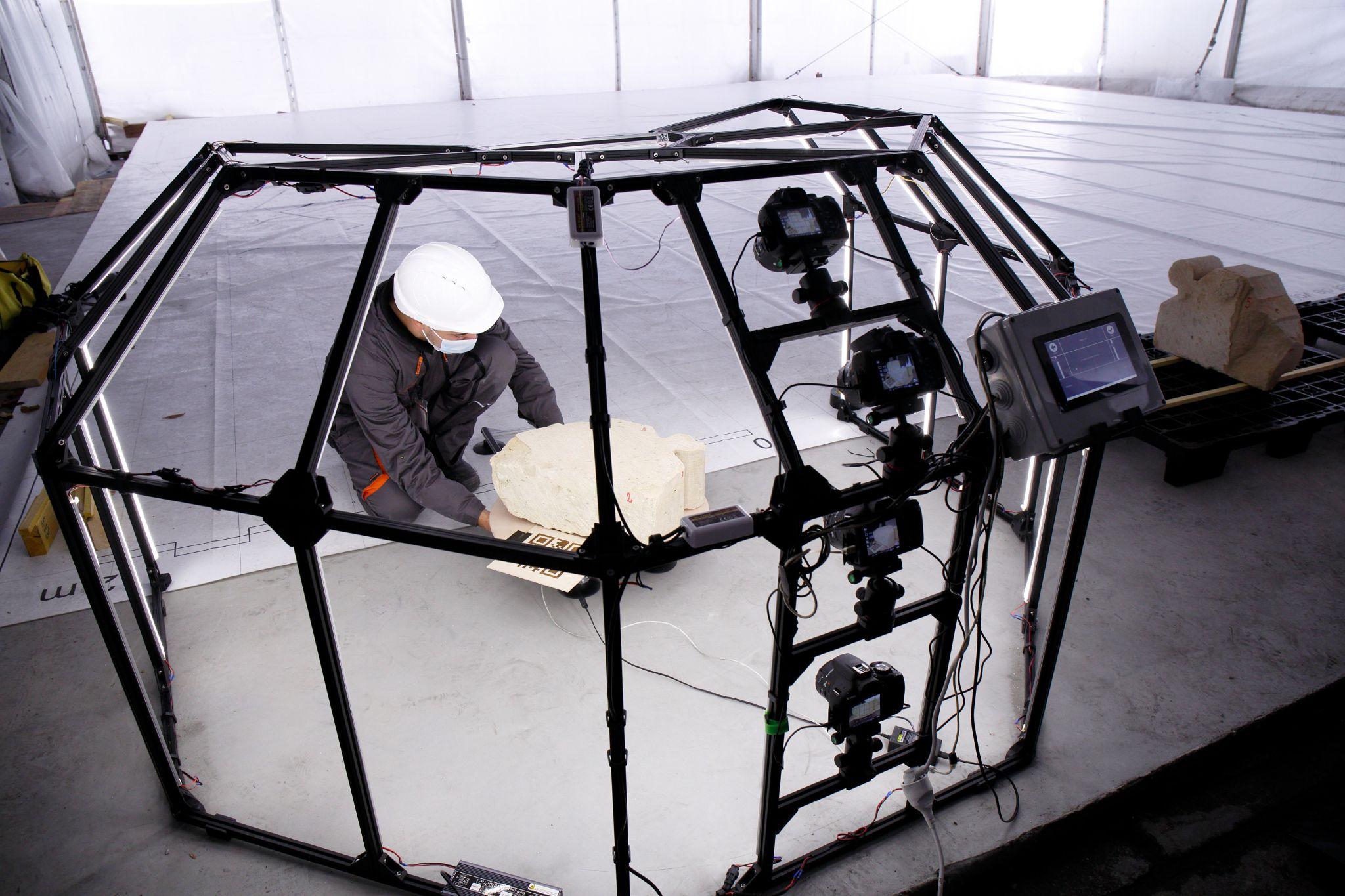
The service consists of a hardware platform composed of several prototypes for 3D digitization (image-based modeling) for capturing on-site the geometry and/or the appearance on large collection of heritage objects at multiple scales (from 2cm to several meters). The service could be extended to advanced processing, visualization of geometric and semantic enrichment (digital twin, scientific imaging, immersive visualisation, computing servers). The MOLAB configuration is only accessible to medium and large collection of immovable objects. The MOLAB configuration is calibrated for 1 week of service, for additional or extended period on-site training are required for the service requester to be autonomous. Small collection of movable CH objects could also be digitized in-lab in FIXLAB configuration.
The size and the characteristics of the object’s collection define the prototype to be used for optimal digitization. The SPIDER can digitize between 0,25m3 and 1m3 cubical objects. The STUDIO can digitize between 2cm3 and 30cm3 cubical objects. The ARCH can digitize horizontal cylindrical shapes of 50cm radius and several meters length. Other prototype are available with lower readiness level to modelize the appearance of the object (multiview RTI based) or survey complex interior (multicamera 360° rig).
MOLAB configuration is accessible only for medium or large collection of objects (minimum a dozen artefacts to be digitized).
The MOLAB configuration is calibrated for 1 week of service, for additional or extended period on-site training are required for the service requester to be autonomous.
Fields of application
Archaeology
Archaeometry
Architectural conservation
Materials
Non reflective
Non reflective
stone
wood
Metal
composite
organic
Methods
Other information
-
Input: Any
-
Output: 2D images in RAW, color calibrated images (JPG or TIFF), Oriented cameras (XML), Geometric calibration (XML), 3D pointcloud (PLY or other), textured 3D model (PLY, OBJ or other), Metadata and paradata (JSON), Processing Report (PDF)