

Service: SECYR: Laser-Induced Breakdown Spectroscopy (LIBS) analyses of archaeological materials
Platforms
Fixlab
Techniques
Laser induced breakdown spectroscopy (libs)
Technology Readiness Level
8 - service complete and qualified (release candidate)
Organization

Service contact persons
Phone:34914976904
The SECYR laboratory’s expertise in the application of Laser-Induced Breakdown Spectroscopy (LIBS) to archaeological materials enables it to conduct studies that effectively address questions posed by historical and archaeological research. This is achieved through the characterization of the inorganic materials most commonly found at archaeological sites—such as metals, ceramics, mural paintings, glass, bone, and ivory.
Service for the Conservation, Restoration and Scientific Studies of Archaeological Heritage (SECYR) is an interdisciplinary laboratory dedicated to the study and conservation of archaeological materials. Due to its long experience in the field, since its foundation in 2006, and the availability and applicability of a set of instrumental techniques, it offers a solid facility capable of conducting scientific analyses on a broad range of archaeological objects.
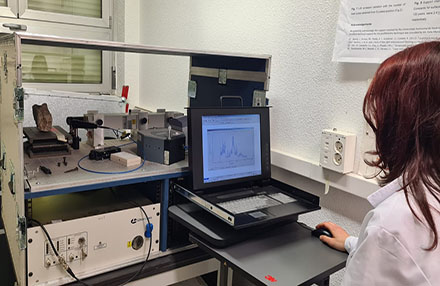
Due to its involvement in research on the application of laser technologies for the conservation and analysis of cultural heritage, the laboratory is equipped with a LIBS (Laser-Induced Breakdown Spectroscopy) system. This allows for the elemental characterization of inorganic materials commonly found in heritage contexts, including metals, ceramics, glass, lithic materials, bone, and ivory.
As a micro-destructive technique, LIBS analyses the atomic signal emitted by the resulting plasma of the ablation of a minute amount of material from the sample´s surface. This makes it particularly effective for identifying the composition of surface treatments and decorative layers, such as ceramic slips or painted layers on wall paintings or ceramic vessels. Moreover, the minimal material removal becomes an advantage in this context, as it facilitates the stratigraphic analysis. By recording successive measurements as the laser pulses impact the same spot, it is possible to monitor the compositional variation with depth. This capability is especially useful for assessing surface alteration processes, such as corrosion or weathering.
LIBS can be applied independently or in combination with other methods available at the laboratory (XRF and Raman spectroscopy). All studies are supported by the expertise of the laboratory team in conservation of archaeological materials, ensuring both the careful handling of complex, heterogeneous objects and the correct interpretation of analytical data.
In addition, SECYR operates under a quality management system certified by IQNET and AENOR, complying with the ISO 9001:2015 standard. The certified scope includes: “the design, development, realization of restoration works belonging to the archaeological heritage and characterization tests through X-ray fluorescence techniques, Raman spectroscopy and laser lnduced breakdown spectroscopy (LIBS)”.
The LIBS system cannot detect volatile elements such as chlorine and bromine. Samples or pieces must be from archaeological context and have a clear provenance legally declared.
Fields of application
Archaeology
Archaeometry
Conservation (discipline)
Conservation science (cultural heritage discipline)
Heritage science (cultural heritage discipline)
Historical archaeology
Prehistory (discipline)
Materials
metallic alloys
Pigments
Ceramics
archaeological glass
corrosion compounds
Pigments
minerals
metallic alloys
archaeological glass
Methods
Tools
Other information
-
Input: Images (jpg, tiff), descriptions and archaeological context data of the pieces or samples.
-
Output: Photographic documentation of samples and analytical process, experimental conditions, results (spectra in .asc format and graphic spectra in .png), data interpretation and report.