

Service: Image-driven prompt gamma neutron activation analysis
Platforms
Fixlab
Techniques
Neutron & x-ray imaging -radiography & tomography
Prompt gamma activation analysis (pgaa)
Prompt gamma activation imaging (pgai)
Technology Readiness Level
9 - service proven in operational environment (production)
Organization

Service contact persons
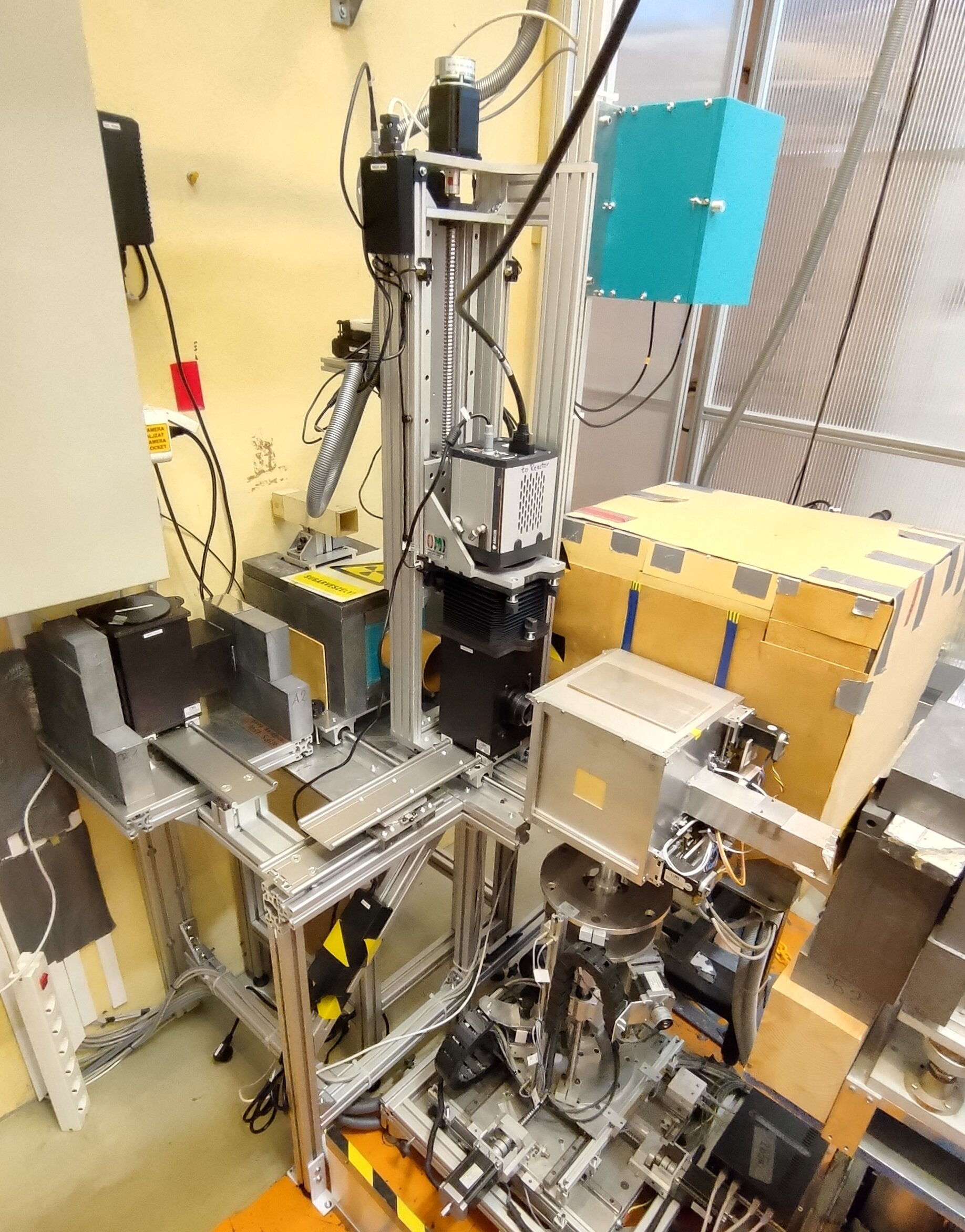
Combining the position-sensitive prompt gamma-ray detection (i.e., image-driven prompt gamma-ray activation analysis at the NIPS) and neutron radiography/tomography (NR/NT at the NORMA), it is possible to determine localized amount of major elements and to visualize internal structures of heterogeneous objects in a non-destructive way. This service is available at the Budapest Neutron Centre.
When analyzing heterogeneous objects, it is more relevant to determine localized composition data specific to smaller, well-confined analysis volumes and thereby to differentiate between adjacent parts of the sample rather than just measuring the bulk average.
As a result of the image-driven prompt gamma-ray activation analysis, instead of a bulk average, the local elemental composition could be determined and the concentrations will be attributed to a certain region of those objects. It is the extension of the PGAA method towards the detailed characterization of these non-homogeneous or heterogeneous objects. The advantage is that scientific questions can be better addressed by a combined interpretation of topological, visual, and compositional information.
The analytical signal in PGAA emerges from a volume at the geometrical intersection of the neutron-beam path throughout the sample and the gamma detector collimator’s solid angle, which is called the isovolume. If the object is systematically translated to the nodes of a regular 1D, 2D, or even a 3D grid, this approach can be generalized to make PGAA capable of analyzing complex heterogeneous objects. This position-sensitive variant of PGAA is called prompt-gamma activation imaging (PGAI). The point-wise scan of the entire object with a few mm-resolution is often unnecessary or impossible, especially considering its excessive beam-time requirement. However, if a priori knowledge is available about the structure, localized element analysis can be carried out at only a few, carefully selected points. Based on the real-time acquired imaging projections as a visual feedback, or on the 3D tomogram, the selected regions of interest can be moved one after the other to the position of the isovolume (this is the so-called image-driven PGAA). The sampling volume of the element analysis can be reduced from several cm3 to few hundred mm3 at most, while the concentrations can be measured at several spots.
The investigations can be carried out at NIPS-NORMA station, which provides the unique joint combination of the two necessary techniques.
Object's dimension could be a limitation factor.
Before accomplishing neutron imaging the temporary activation of the object must be assessed to decide about the feasibility of the service.
The very long spectrum acquisition time limits the number of the points, which can be measured.
Fields of application
Heritage science (cultural heritage discipline)
Materials
Metals and alloys
Ceramics
Stones
complex objects