

Service: Neutron and X-ray-Imaging
Platforms
Fixlab
Techniques
Neutron & x-ray imaging -radiography & tomography
Technology Readiness Level
9 - service proven in operational environment (production)
Organization

Service contact persons
Exploiting the position-wise transmission of the neutron and X-ray beam through objects visual information on the macro- and microscopic structure and/or inner processes can be obtained. The different interaction of the two types of radiation (X-ray – with electron shell, neutron – with nucleus) gives complementary information. Users are offered by radiographic (2D imaging) or tomographic (3D imaging) datasets depending on both the tasks to be fulfilled and the available technical possibilities. This service is available at the Budapest Neutron Centre.
Objects in the neutron or X-ray beam produce attenuation-based contrast on the scintillation screens. Measurable materials are natural, cultural heritage and engineered objects (e.g., Hydrogen-containing materials). The range of investigated features cover 2D and/or 3D macroscopical morphological, structural and real-time process information via static and/or dynamic imaging. A usual penetration depth of the radiation applied is in the range of mm’s – cm’s.
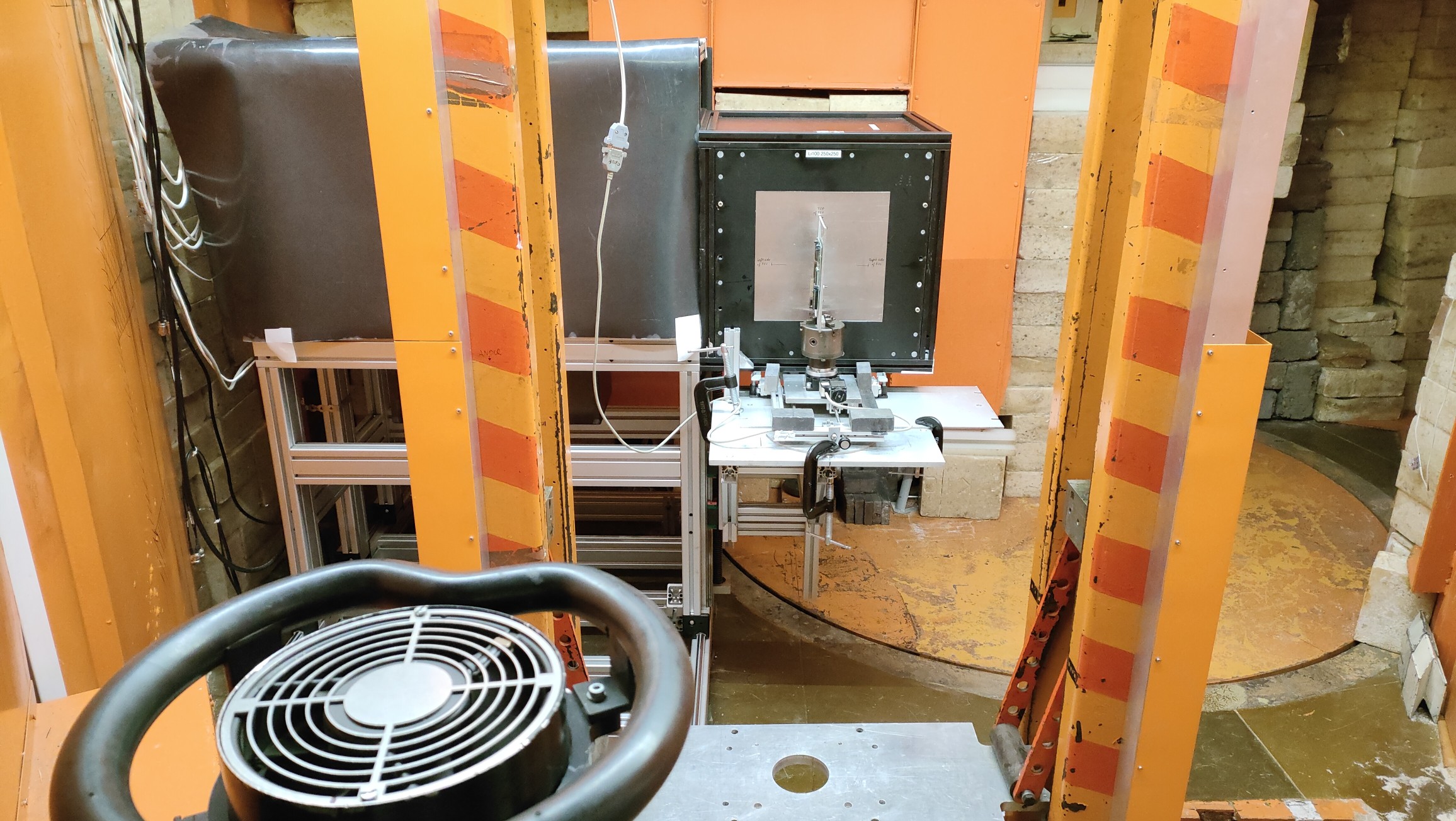
The RAD (Static/dynamic white-beam-neutron and X-ray imaging station) imaging facility is a versatile system, which makes use of various radiations (thermal, epithermal and fast neutrons, moreover, X-rays) to benefit from their complementary nature, and is used to obtain information on the structure and/or inner processes of a given object. The white-beam neutron imaging facility is served by an in-pile, Cd-covered pin-hole-type collimator placed within the horizontal channel No. 2. It is utilized for various non-destructive test measurements, on either a static or dynamic system. Usually, static imaging is carried out for many types of objects from the field of cultural heritage (e.g., sculptures, swords, ceramics) to engineering objects (e.g., automotive parts, batteries, inserts).
The NORMA (Neutron Optics and Radiography for Material Analysis) station is one of the complementary parts of the NIPS-NORMA facility. It has been designed for neutron radiography (NR) and tomography (NT), and as position feedback for imaging-driven Prompt Gamma Activation Imaging (PGAA). Objects are positioned in a sample chamber, where the beam’s size can continuously be adjusted up to its maximum of 40×40 mm2. The NORMA facility is located at the end position of the neutron guide No. 10/1 in the cold neutron hall of the Budapest Research Reactor.
Image processing: For the manipulation, reconstruction, and visualization of the 3D neutron and X-ray datasets (i.e., the tomographic images), the latest Fiji-ImageJ, Octopus 8.9, and VGStudio MAX 3.2 and KipTool software packages are used.
The triad of spatial resolution, exposure time and field of view should always be optimized.
Before accomplishing neutron imaging the temporary activation of the object must be assessed to decide about the feasibility of the service.
Object's dimension could be a limitation factor.
Fields of application
Heritage science (cultural heritage discipline)
Materials
complex objects
Ceramics
wood
Metal
Bone (material)
Porous materials
complex objects
Methods